

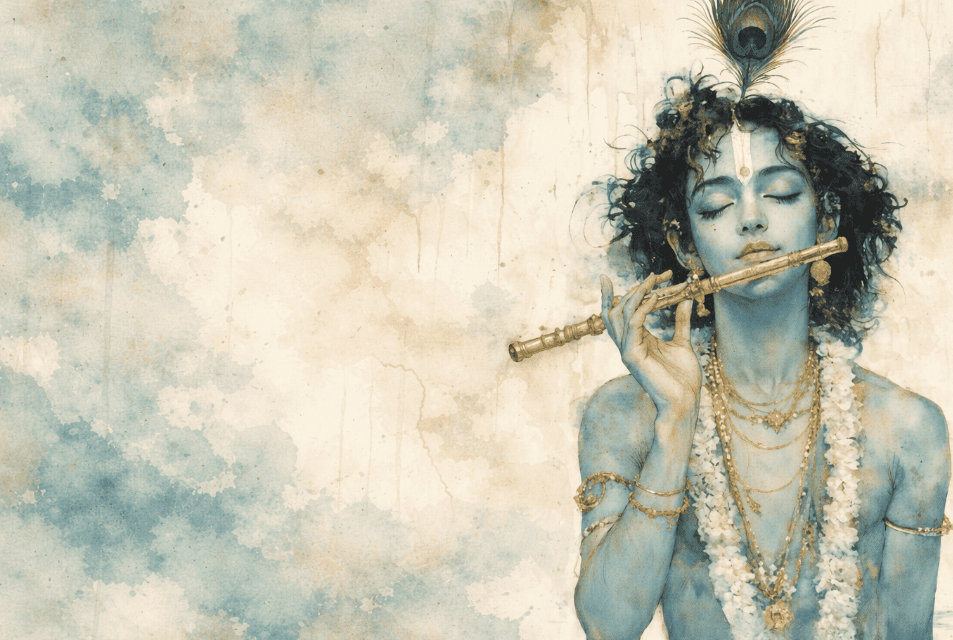
Akṣhar Brahma Yog
Yoga of the Imperishable Absolute
This chapter teaches about the imperishable reality (Akṣhara) and the eternal soul. It contrasts the perishable world of change with the unchanging Brahman that is beyond birth and death.
Arjuna learns how the state of mind at the moment of death shapes where the soul goes next. Remembering the Lord leads to liberation; attachment to sense objects leads to rebirth.
Krishna gives practical spiritual tools: the sacred syllable Om, steady meditation, and control of the mind and life-force. These help a seeker remain steady at the final moment.
The chapter also explains different kinds of beings and destinations after death, and how knowledge, devotion, and disciplined practice free one from the cycle of birth and death.
Overall, the core message is that steady remembrance of the Divine, practiced now, prepares the soul for a peaceful and final return to the eternal.
Key Teachings
- The soul (Ātman) and Brahman are imperishable; the body and world are temporary.
- The last thought at death determines where the soul goes; remembering the Lord leads to the highest goal.
- Use Om and focused meditation to fix the mind on the Divine at all times.
- Control of breath and mind, plus steady practice, gives the yogi the power to leave the body peacefully.
- Attachment to senses keeps one in the cycle of rebirth; knowledge and devotion break that cycle.
Life Application
- Practice short, regular meditations or a simple mantra (like Om) to build a steady habit of remembrance.
- Keep awareness of your deeper goal; let it guide choices instead of momentary desires.
- Train the mind with breath control and simple discipline so you remain calm in difficult moments.
Reflection Question
If you could choose one thought to hold in your last moment, what would it be?
Verses in this Chapter
Arjuna said, "What is Brahman? What is Adhyatma? What is action, O best among men? What is Adhibhuta declared to be? And, what is Adhidaiva said to be?" Who and how is Adhiyajna here in this body, O destroyer of Madhu? And how, at the time of death, are You to be known by the self-controlled?
The Blessed Lord said, "Brahman is the Imperishable, the Supreme; its essential nature is called Self-knowledge; the offering (to the gods) that causes the existence and manifestation of beings and sustains them is called action."
Adhibhuta—knowledge of the elements—pertains to My perishable nature, and the Purusha, or the Soul, is the Adhidaiva; I alone am the Adhiyajna here in this body, O best among the embodied.
And whoever, leaving their body, goes forth remembering Me alone at the time of death, they will attain My Being; there is no doubt about this.
Whoever at the end leaves the body, thinking of any being, to that being only does he go, O son of Kunti (Arjuna), due to his constant thought of that being.
Therefore, at all times, remember Me only and fight. With your mind and intellect fixed on Me, you will undoubtedly come to Me alone.
With the mind not moving towards any other thing, made steadfast through the practice of habitual meditation, and constantly meditating, one goes to the Supreme Person, the Resplendent, O Arjuna.
Whosoever meditates on the Omniscient, the Ancient, the Ruler of the whole world, minuter than an atom, the supporter of all, of inconceivable form, effulgent like the sun and beyond the darkness of ignorance. At the time of death, with an unwavering mind, endowed with devotion, by the power of Yoga, fixing the whole life-breath in the middle of the two eyebrows, he reaches that resplendent Supreme Person.
That which is declared to be Imperishable by those who know the Vedas, that which the self-controlled (ascetics or Sannyasins) and passion-free enter, that goal, desiring which celibacy is practised, I will declare to thee in brief.
Having closed all the gates, confined the mind in the heart, and fixed the life-breath in the head, engage in the practice of concentration.
Uttering the one-syllabled Om, the Brahman, and remembering Me, he who departs, leaving the body, attains the Supreme Goal.
I am easily attainable by that ever-steadfast yogi who constantly and daily remembers me for a long time, not thinking of anything else with a single-minded or one-pointed focus, O Partha.
Having attained Me, these great souls do not take birth again here—a place of pain and impermanence—but have reached the highest perfection of liberation.
All the worlds, including the world of Brahma, are subject to return again, O Arjuna; but he who reaches Me, O son of Kunti, has no rebirth.
Those who know the day of Brahma, which lasts a thousand Yugas, and the night, which also lasts a thousand Yugas, know day and night.
From the Unmanifested, all the manifested worlds proceed upon the arrival of the 'day'; upon the arrival of the 'night', they dissolve indeed into that which is known as the Unmanifested.
This same multitude of beings, being born again and again, helplessly dissolves, O Arjuna, into the Unmanifested at the coming of the night and comes forth at the coming of the day.
But verily, there exists higher than this Unmanifested, another Unmanifested Eternal, which is not destroyed even when all beings are destroyed.
What is known as the Unmanifested and the Imperishable, That is said to be the highest goal. Those who reach It do not return (to this Samsara). That is My supreme abode (place or state).
That highest Purusha, O Arjuna, is attainable by unswerving devotion to Him alone, within Whom all beings dwell and by Whom all this is pervaded.
Now I will tell you, O chief of the Bharatas, the times of departure at which the Yogis will return or not return. Fire, light, daytime, the bright fortnight, the six months of the northern path of the sun (the northern solstice) departing, then men who know Brahman go to Brahman. Attaining the lunar light through smoke, night time, the dark fortnight, and the six months of the southern path of the sun (the southern solstice), the yogi returns. The bright and dark paths of the world are thought to be eternal; one leads to no return, and the other leads to return.
Knowing these paths, O Arjuna, no yogi is deluded; therefore, at all times, be steadfast in yoga.
Whatever fruit of merit is declared (in the scriptures) to accrue from (the study of) the Vedas, (the performance of) sacrifices, (the practice of) austerities, and gifts, beyond all this goes the Yogi, having known this; and he attains to the Supreme, Primeval (first or ancient) Abode.