

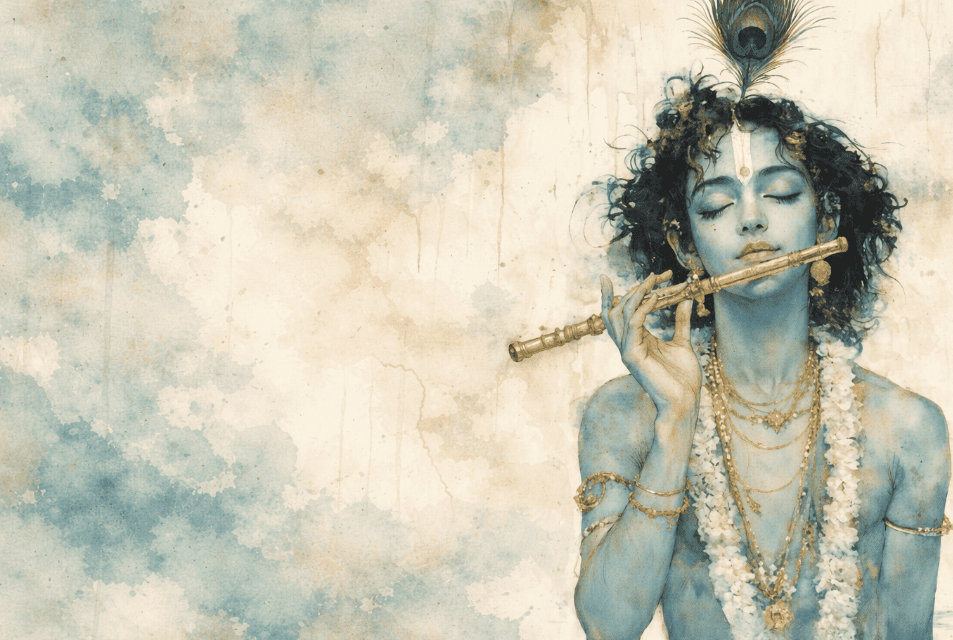
Jñāna Karm Sanyās Yog
Yoga of Knowledge, Action, and Renunciation
This chapter explains how true knowledge (jñāna) and right action (karma) work together. Krishna teaches that spiritual wisdom is not separate from daily duties; knowing the truth changes how we act. He describes the idea of performing duty without attachment to results (nishkama karma) as the path to freedom.
Krishna also speaks about his divine role and how sacred knowledge is passed down through teachers. He stresses that renouncing the fruits of action, not action itself, is the real renunciation. Wisdom removes ignorance, and selfless action becomes a form of worship.
The chapter gives practical steps for gaining wisdom: humility, steady practice, and study under a teacher. It shows that both knowledge and action can lead to the same goal when done with right understanding and devotion.
Overall, the message is practical: act with skill and duty, hold the results lightly, and cultivate clear insight to free yourself from bondage.
Key Teachings
- Act without attachment to the fruits of work (nishkama karma); this frees the mind.
- True renunciation is giving up desire for outcomes, not stopping work.
- Knowledge removes ignorance; study, humility, and steady practice help you gain this knowledge.
- Perform actions as sacrifice (yajña) or service, making work sacred and purifying.
- Different paths (knowledge, action, devotion) converge when pursued with right understanding.
Life Application
- Do your duties fully, but accept outcomes without clinging—focus on effort, not reward.
- Learn from teachers and texts with humility; build steady habits of study and reflection.
- Treat daily work as service: offer your actions for a greater good to reduce stress and selfishness.
Reflection Question
Where in my life can I let go of attachment to results and simply do my duty?
Verses in this Chapter
The Blessed Lord said, "I taught this imperishable Yoga to Vivasvan; he then told it to Manu; Manu proclaimed it to Ikshvaku.
This, handed down in regular succession by the royal sages, was known. This Yoga, however, has been lost here over time, O Parantapa (burner of the foes).
That same ancient yoga has been today taught to you by me, for you are my devotee and my friend; it is the supreme secret.
Arjuna said, "Later was Thy birth, and prior to it was the birth of Vivasvan (the Sun); how am I to understand that Thou hast taught this Yoga from the beginning?"
The Blessed Lord said, "Many births of Mine have passed, as well as of thine, O Arjuna; I know them all, but thou knowest not, O Parantapa (scorcher of foes)."
Though I am unborn and of imperishable nature, and though I am the Lord of all beings, yet, governing my own nature, I am born by my own Maya.
Whenever there is a decline of righteousness and an increase of unrighteousness, O Arjuna, then I manifest Myself.
For the protection of the good, for the destruction of the wicked, and for the establishment of righteousness, I am born in every age.
He who thus knows, in their true light, My divine birth and actions, having abandoned the body, is not born again; he comes to Me, O Arjuna.
Freed from attachment, fear, and anger, absorbed in Me, taking refuge in Me, purified by the fire of knowledge, many have attained My Being.
In whatever way men approach Me, even so do I reward them; My path do men tread in all ways, O Arjuna.
Those who long for success in action in this world sacrifice to the gods; for success is quickly attained by men through action.
The fourfold caste has been created by Me according to the differentiation of Guna and Karma; though I am the author of it, know Me as non-doer and immutable.
Actions do not taint Me, nor do I have a desire for the fruit of actions. He who knows Me thus is not bound by actions.
Having known this, the ancient seekers of freedom also performed action; therefore, do thou also perform action, as the ancients did in days of yore.
What is action? What is inaction? Even the wise are confused about this. Therefore, I shall teach you the nature of action and inaction, by knowing which you will be liberated from the evil of Samsara, the wheel of birth and death.
For verily, the true nature of action enjoined by the scriptures should be known, as well as that of forbidden or unlawful action, and of inaction; the nature of action is hard to understand.
He who sees inaction in action and action in inaction, he is wise among men; he is a yogi and performer of all actions.
He whose undertakings are all devoid of desires and selfish purposes, and whose actions have been burned by the fire of knowledge, the wise call him a sage.
Having abandoned attachment to the fruits of the action, ever content, depending on nothing, he does not do anything even while being engaged in activity.
Without hope, controlling the mind and the self, having abandoned all covetousness, and performing only bodily actions, one incurs no sin.
Content with what comes to him without effort, free from the pairs of opposites and envy, even-minded in success and failure, he acts yet is not bound.
To one who is devoid of attachment, who is liberated, whose mind is established in knowledge, and who works for the sake of sacrifice (for the sake of God), the whole action is dissolved.
Brahman is the oblation; Brahman is the melted butter (ghee); by Brahman is the oblation poured into the fire of Brahman; Brahman indeed shall be attained by one who always sees Brahman in action.
Some yogis perform sacrifice to the gods alone; while others, who have realized the Self, offer the Self as sacrifice in the fire of Brahman alone.
Some again offer the organ of hearing and other senses as a sacrifice in the fire of restraint; others offer sound and other objects of the senses as a sacrifice in the fire of the senses.
Others again sacrifice all the functions of the senses and those of the breath (vital energy, or Prana) in the fire of the Yoga of self-restraint, kindled by knowledge.
Others again offer wealth, austerity, and Yoga as sacrifice, while ascetics of self-restraint and rigid vows offer the study of scriptures and knowledge as sacrifice.
Others offer as sacrifice the outgoing breath into the incoming, and the incoming into the outgoing, restraining the flow of the outgoing and the incoming breaths, solely absorbed in the restraint of the breath. Others who regulate their diet offer life-breaths in each life-breath. All these are knowers of sacrifice, whose sins are destroyed through sacrifice.
Those who eat the remnants of the sacrifice, which are like nectar, go to the eternal Brahman. This world is not for the one who does not perform sacrifice; how then can they have the other, O Arjuna?
Thus, manifold sacrifices are spread out before Brahman at the face of Brahman. Know them all to be born of action, and thus knowing, you shall be liberated.
Superior is wisdom-sacrifice to the sacrifice with objects, O Parantapa (scorcher of the foes). All actions in their entirety, O Arjuna, culminate in knowledge.
Know that the wise who have realized the truth will instruct thee in that knowledge through long prostration, supplication, and service.
Knowing that thou shalt not, O Arjuna, again be deluded like this; and by that thou shalt see all beings in thyself and also in me.
Even if thou art the most sinful of all sinners, yet thou shalt surely cross over all sins by the raft of knowledge.
As the blazing fire reduces fuel to ashes, O Arjuna, so does the fire of knowledge reduce all actions to ash.
Verily, there is no purifier in this world like knowledge. He who is perfected in Yoga finds it within the Self in due time.
The one who is full of faith, devoted to it, and has subdued their senses obtains this knowledge; and upon obtaining the knowledge, they attain the supreme peace immediately.
The ignorant, the faithless, and the doubting self go to destruction; there is neither this world nor the other, nor happiness for the doubting one.
He who has renounced actions through Yoga, whose doubts have been dispelled by knowledge, and who is self-possessed—such a one is not bound by actions, O Arjuna.
Therefore, with the sword of knowledge (of the Self), cut asunder the doubt of the self, born of ignorance, residing in your heart, and take refuge in Yoga. Arise, O Arjuna!