

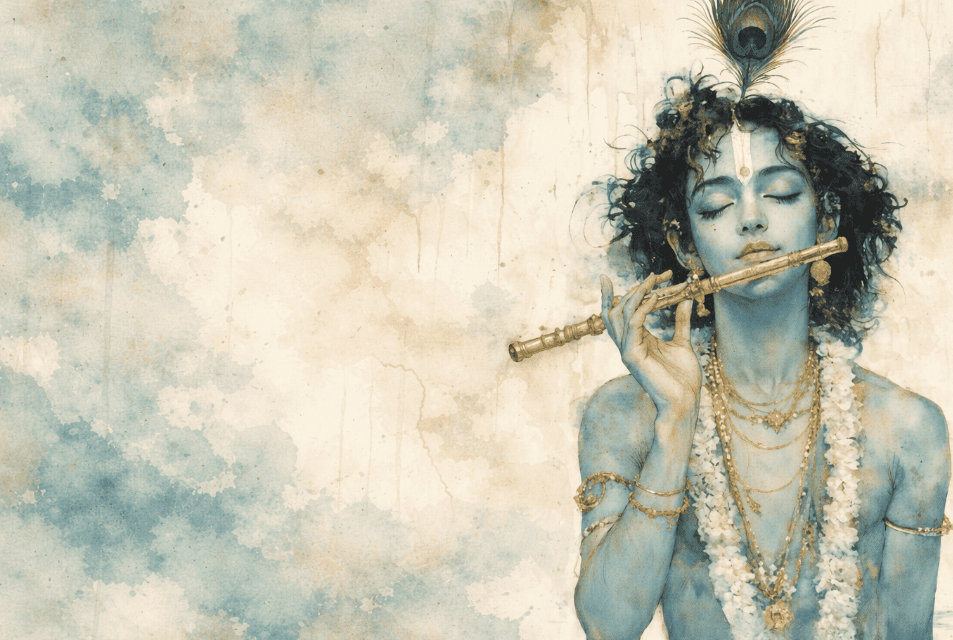
Karm Sanyās Yog
The Yoga of Renouncing Action
Chapter Theme
This chapter explains the difference between outward renunciation (giving up actions) and inner renunciation (giving up attachment to results). Krishna teaches that true freedom comes from the mind, not from abandoning work.
He says doing your duty without desire for personal reward leads to the same goal as full renunciation. Action done with detachment is clearer, steadier, and often more practical for most people.
The chapter stresses self-control and steady practice. When the mind is calm and free from craving, a person finds lasting peace and is not shaken by praise, blame, gain, or loss.
Seeing the same Self in everyone removes hatred and increases compassion. Knowledge of the true Self plus disciplined action leads to liberation.
Key Teachings
- Renouncing the fruits of action, not action itself, brings inner freedom.
- Acting with equanimity and self-control is superior to mere outward withdrawal.
- Knowledge of the true Self steadies the mind and ends suffering.
- A liberated person remains calm in all situations and treats others without hatred.
Life Application
- Do your duties sincerely but release worry about outcomes; evaluate effort, not results.
- Practice simple daily discipline: calm the mind with short periods of steady breathing or focused attention.
- Notice reactions to praise and blame; work to stay balanced and kind in both success and failure.
Reflection Question
When have you acted for the result rather than for the right reason, and how might you change that approach?
Verses in this Chapter
Arjuna said, "O Krishna, you praise renunciation of actions and also yoga. Please tell me conclusively which is better of the two."
The Blessed Lord said, "Renunciation and the Yoga of action both lead to the highest bliss; but of the two, the Yoga of action is superior to the renunciation of action."
He should be known as a perpetual Sannyasi who neither hates nor desires; for, free from the pairs of opposites, O mighty-armed Arjuna, he is easily freed from bondage.
Children, not the wise, speak of knowledge and the Yoga of action, or the performance of action, as though they are distinct and different; he who is truly established in one, obtains the fruits of both.
That place which is reached by the Sankhyas or the Jnanis is also reached by the Yogis (Karma Yogis). He who sees knowledge and the performance of action (Karma Yoga) as one, sees truly.
But, O mighty-armed Arjuna, renunciation is hard to attain without Yoga; the sage who is in harmony with Yoga quickly goes to Brahman.
He who is devoted to the path of action, whose mind is pure, who has conquered the self, who has subdued his senses, and who realizes his Self as the Self in all beings, though acting, is not tainted.
I do nothing at all," thus would the harmonized knower of Truth think, seeing, hearing, touching, smelling, eating, going, sleeping, and breathing. Speaking, letting go, seizing, opening, and closing the eyes, one should be convinced that the senses move among the sense-objects.
He who does actions, offering them to Brahman and abandoning attachment, is not tainted by sin, just as a lotus leaf is not tainted by water.
Yogis, having abandoned attachment, perform actions only through the body, mind, intellect, and even the senses, for the purification of the self.
The one who is united (the well-poised or harmonized) having abandoned the fruit of action attains eternal peace; whereas the one who is not united (the unsteady or unbalanced), impelled by desire and attached to the fruit, is bound.
Mentally renouncing all actions and being self-controlled, the embodied one happily rests in the nine-gated city, neither acting nor causing others (body and senses) to act.
Neither does the Lord create agency nor actions for the world, nor union with the fruits of actions; rather, it is Nature that acts.
The Lord takes neither the demerit nor the merit of any; knowledge is enveloped by ignorance, and beings are deluded.
But to those whose ignorance is destroyed by knowledge of the Self, like the sun, knowledge reveals the Supreme Brahman.
Their intellect absorbed in That, their self being That, established in That, with That as their supreme goal, they go whence there is no return, their sins dispelled by knowledge.
Sages look with an equal eye on a Brahmana endowed with learning and humility, on a cow, an elephant, a dog, and even an outcaste.
Even here in this world, those whose minds rest in reality overcome birth; Brahman is indeed spotless and real; therefore they are established in Brahman.
Resting in Brahman, with a steady intellect and undeluded, the knower of Brahman neither rejoices upon obtaining what is pleasant nor grieves upon obtaining what is unpleasant.
With the self unattached to external contacts, he finds happiness in the Self; with the self engaged in the meditation of Brahman, he attains endless happiness.
The enjoyments that arise from contact are only sources of pain, for they have a beginning and an end, O Arjuna; the wise do not rejoice in them.
He who is able, while still here in this world, to withstand the impulse born out of desire and anger before the liberation from the body, he is a Yogi, and he is a happy man.
He who is happy within, who rejoices within, and who is illuminated within, that Yogi attains absolute freedom, or Moksha, becoming Brahman himself.
The sages obtain absolute freedom or Moksha when their sins have been destroyed, their dualities have been torn asunder, they are self-controlled, and they are intent on the welfare of all beings.
Absolute freedom exists on all sides for those self-controlled ascetics who are free from desire and anger, who have controlled their thoughts, and who have realized the Self.
Shutting out all external contacts and fixing the gaze between the eyebrows, realizing the outgoing and incoming breaths moving within the nostrils. With the senses, mind, and intellect ever controlled, having liberation as their supreme goal, free from desire, fear, and anger, the sage is truly liberated forever.
He who knows Me as the enjoyer of sacrifices and austerities, the great Lord of all the worlds, and the friend of all beings, attains peace.