

Dhyān Yog
The Yoga of Meditation
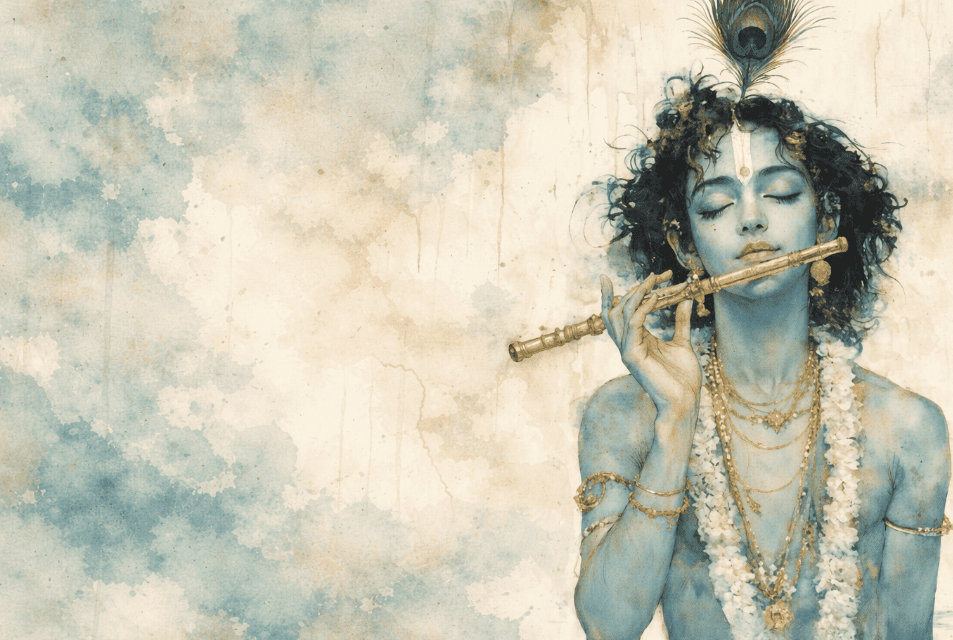
This chapter teaches how to calm and steady the mind through meditation. It explains that the goal is self-realization — seeing the true Self beyond changing thoughts and feelings. Krishna shows practical steps: discipline, moderation, posture, breath control, and withdrawal of the senses.
The chapter balances effort and surrender. It says steady practice is needed, but results should be offered without attachment. A steady mind is both the tool and the reward of meditation.
Krishna warns that the mind can be our best friend or worst enemy. With patience and right practice it becomes peaceful; without control it pulls us into confusion and suffering.
Ultimately the chapter points to inner freedom and deep peace. Even ordinary people who practice sincerely can reach the highest state, not only monks.
Key Teachings
- Regular, disciplined practice quiets the mind and leads to self-knowledge.
- Moderation in sleep, food, and work supports meditation.
- Withdraw the senses and focus the mind gently; posture and breath help.
- The mind can be controlled by practice and detachment; be patient and persistent.
- Steadiness and equanimity toward success and failure lead to inner freedom.
Life Application
- Set a short, regular time each day to sit quietly, keep a straight but relaxed posture, and watch your breath.
- Keep daily habits moderate (eat and sleep little but enough) to support mental clarity.
- When the mind wanders, bring it back gently without self-judgment; offer results of practice without attachment.
Reflection Question
What one small daily habit could help you become more steady and calm in your mind?
Verses in this Chapter
The Blessed Lord said: He who performs his bounden duty without depending on the fruits of his actions—he is a sannyasi and a yogi, not he who is without fire and without action.
Do you, O Arjuna, know that Yoga is what they call renunciation; no one indeed becomes a Yogi who has not renounced their thoughts.
For a sage who wishes to attain to Yoga, action is said to be the means; for the same sage who has attained Yoga, inaction is said to be the means.
When a person is not attached to the sense-objects or to actions, having renounced all thoughts, then they are said to have attained Yoga.
One should raise oneself by one's own self alone; let not one lower oneself; for the self alone is one's own friend, and the self alone is one's own enemy.
The Self is the friend of the self of him by whom the Self has been conquered; but to the unconquered self, this Self stands in the position of an enemy, like an external foe.
The Supreme Self of him who is self-controlled and peaceful remains balanced in cold and heat, pleasure and pain, as well as in honor and dishonor.
The Yogi who is satisfied with the knowledge and wisdom of the Self, who has conquered the senses, and to whom a clod of earth, a piece of stone, and gold are all the same, is said to have attained Nirvikalpa Samadhi.
He who is of the same mind towards the good-hearted, friends, enemies, the indifferent, the neutral, the hateful, the relatives, the righteous, and the unrighteous, excels.
Let the yogi constantly strive to keep the mind steady, remaining in solitude, alone, with the body and mind controlled, and free from hope and greed.
In a clean spot, having established a firm seat of his own, neither too high nor too low, made of cloth, skin, and kusha grass layered one over the other.
There, having made the mind one-pointed, with the actions of the mind and senses controlled, let him, seated on the seat, practice Yoga for the purification of the self. Let him firmly hold his body, head, and neck erect and still, gazing at the tip of his nose without looking around.
Serene-minded, fearless, firm in the vow of a Brahmachari, having controlled their mind, thinking of Me and balanced in mind, let them sit, having Me as their supreme goal.
Thus, always keeping the mind balanced, the yogi, with the mind controlled, attains the peace abiding in Me, culminating in liberation.
Verily, Yoga is not possible for him who eats too much, nor for him who does not eat at all, nor for him who sleeps too much, nor for him who is always awake, O Arjuna.
Yoga becomes the destroyer of pain for him who is moderate in eating and recreation (such as walking, etc.), who exercises moderation in action, and who is moderate in sleep and wakefulness.
When the perfectly controlled mind rests in the Self alone, free from longing for any of the objects of desire, then it is said, 'He is united'.
As a lamp placed in a windless spot does not flicker, so is the Yogi of a controlled mind, who practices Yoga in the Self, compared.
When the mind, restrained by the practice of yoga, attains quietude, and when one sees the Self by the Self, they are satisfied in their own Self.
When he (the Yogi) feels that infinite bliss which can be grasped by the pure intellect and which transcends the senses, and is established therein, never moving away from the reality.
Having obtained it, he thinks there is no other gain superior to it; established in it, he is not moved even by heavy sorrow.
Let this be known by the name of Yoga, the severance from union with pain. This Yoga should be practiced with determination and with an undespairing mind.
Abandoning unreservedly all desires born of Sankalpa (thought and imagination) and completely restraining the whole group of senses by the mind from all sides. Little by little, let him attain steadiness of the intellect by holding it firmly; having made the mind establish itself in the Self, let him not think of anything else.
From whatever cause the restless and unsteady mind wanders away, let him restrain it from that and bring it under the control of the Self alone.
Supreme Bliss indeed comes to this Yogi whose mind is made peaceful, whose passion is quelled, who has become Brahman, and who is free from sin.
The yogi, always engaging the mind thus (in the practice of yoga), is freed from sins and easily enjoys the infinite bliss of contact with Brahman (the Eternal).
With the mind harmonized by Yoga, he sees the Self abiding in all beings and all beings in the Self; he sees the same everywhere.
He who sees Me everywhere and sees everything in Me, never becomes separated from Me, nor do I from him.
He who, being established in unity, worships Me, who dwells in all beings, that yogi abides in Me, whatever their mode of living may be.
He who, through the likeness of the Self, O Arjuna, sees reality everywhere, be it pleasure or pain, is regarded as the highest Yogi.
Arjuna said, "O Krishna, I do not see how this Yoga of equanimity, which you have taught me, can be maintained steadily, due to the restlessness of the mind."
The mind is indeed restless, turbulent, strong, and unyielding, O Krishna; I consider it as difficult to control as controlling the wind.
The Blessed Lord said, "Undoubtedly, O mighty-armed Arjuna, the mind is difficult to control and restless; but with practice and dispassion, it can be restrained."
I think Yoga is hard to be attained by one with an uncontrolled self, but the self-controlled and striving one can attain it by the appropriate means.
Arjuna said, "He who is unable to control himself, even though he has faith, and whose mind wanders away from Yoga, what end does he meet, having failed to attain perfection in Yoga, O Krishna?"
Fallen from both, does he not perish like a rent cloud, supportless, O mighty-armed one, deluded on the path of Brahman?
O Krishna, please completely dispel this doubt of mine, for it is not possible for anyone but You to do so.
The Blessed Lord said, "O Arjuna, neither in this world nor in the next will there be destruction for him; none, indeed, who does good, O my son, ever comes to grief."
Having attained to the worlds of the righteous and having dwelt there for everlasting years, he who fell from Yoga is born in a house of the pure and wealthy. Or he is born in a family of even the wisest of yogis; verily, such a birth is very difficult to obtain in this world.
Then he comes into contact with the knowledge acquired in his former body and strives even more for perfection, O Arjuna.
By that same former practice, he is borne on in spite of himself. Even he who merely wishes to know Yoga goes beyond the Brahmanic word.
But the Yogi who strives assiduously, purified of sins and perfected gradually over many births, reaches the highest goal.
The yogi is thought to be superior to the ascetics, even superior to those who have knowledge obtained through the study of scriptures; he is also superior to men of action; therefore, be thou a yogi, O Arjuna.
And among all the Yogis, he who, full of faith and with his inner self merged in Me, worships Me is deemed by Me to be the most devoted.