

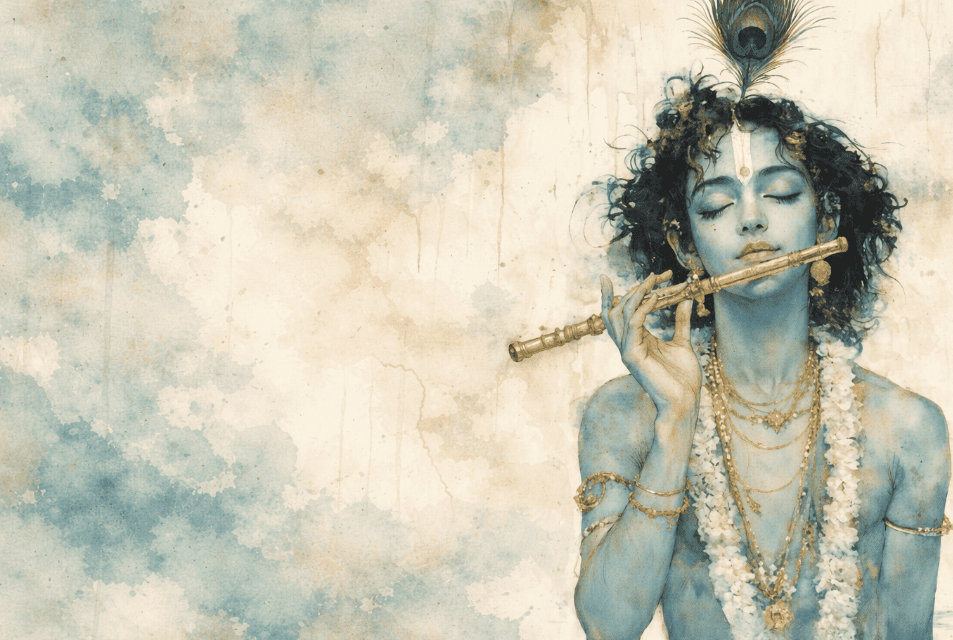
Arjun Viṣhād Yog
Arjuna's Despair and Confusion
We start with the scene on the battlefield of Kurukṣetra and show Arjuna’s deep grief and confusion before the war begins. Faced with killing his own relatives, teachers, and friends, he is torn between duty as a warrior and his love for family.
Arjuna describes the moral cost of the battle and the pain he feels at the thought of causing suffering. His emotions grow so strong that he becomes physically weak and refuses to fight.
This chapter highlights human vulnerability when duty conflicts with attachment and compassion. It shows how attachment and fear can cloud judgment and paralyze action.
The chapter ends with Arjuna turning to Krishna for guidance, signaling the need for clear wisdom when emotions overwhelm reason. It prepares the listener for the teachings that follow.
Key Teachings
- Strong emotions and attachments can block right action and clear thinking.
- Moral dilemmas arise when personal ties conflict with public duty.
- It is natural and honest to acknowledge confusion and ask for help.
- Silence or refusal to act may be a call to seek deeper understanding before deciding.
Life Application
- When overwhelmed, pause and name your emotions rather than acting immediately.
- Seek wise counsel or a steady perspective before making choices that affect others.
- Separate short-term feelings from long-term responsibilities to make clearer decisions.
Reflection Question
What feelings or attachments prevent you from doing what you know is right?
Verses in this Chapter
Dhritarashtra asked: “O Sanjaya, when my sons and the sons of Pandu gathered at Kurukshetra, the sacred field of dharma, eager to fight, what did they do?”
Sanjaya said: Having seen the army of the Pandavas drawn up in battle array, King Duryodhana approached his teacher, Drona, and spoke these words.
Behold, O Teacher! This mighty army of the sons of Pandu, arrayed by the son of Drupada, thy wise disciple.
Here are heroes, mighty archers, equal in battle to Bhima and Arjuna, Yuyudhana (Satyaki), Virata, and Drupada—all mighty warriors. Dhrishtaketu, Chekitana, the valiant king of Kasi, Purujit, Kuntibhoja, and Saibya—the best of men. The strong Yudhamanyu and the brave Uttamaujas, the son of Subhadra (Abhimanyu, the son of Subhadra and Arjuna), and the sons of Draupadi, all of them great charioteers (great heroes)."
Know also, O best among the twice-born! the names of those who are the most distinguished amongst ourselves, the leaders of my army; these I name to you for your information.
"Thou thyself, Bhishma, Karna, Kripa, the victorious in war, Asvatthama, Vikarna, and Bhurisrava, the son of Somadatta—all these are ready for battle."
And also many other heroes, ready to give up their lives for my sake, armed with various weapons and missiles, all well-skilled in battle.
Our army, marshalled by Bhishma, is insufficient, whereas theirs, marshalled by Bhima, is sufficient.
Therefore, do all of you, stationed in your respective positions in the several divisions of the army, protect Bhishma alone.
His glorious grandsire, the oldest of the Kauravas, roared like a lion to cheer Duryodhana and blew his conch.
Then, suddenly, conches, kettledrums, tabors, drums, and cow horns blared forth from the Kaurava side, and the sound was tremendous.
Then, Madhava (Krishna) and the son of Pandu (Arjuna), seated in the magnificent chariot yoked with white horses, blew divine conches.
Hrishikesha blew the Panchajanya, Arjuna blew the Devadatta, and Bhima, the wolf-bellied doer of terrible deeds, blew the great conch Paundra.
King Yudhishthira, the son of Kunti, blew the Anantavijaya; Nakula and Sahadeva blew the Sughosha and the Manipushpaka. The king of Kasi, an excellent archer, Sikhandi, the mighty car-warrior, Dhrishtadyumna, Virata, and Satyaki, the unconquered. Drupada and the sons of Draupadi, O Lord of the Earth, and the son of Subhadra, the mighty-armed, blew their conches each separately.
The tumultuous sound rent the hearts of Dhritarashtra's party, reverberating through both heaven and earth.
Then, seeing the people of Dhritarashtra's party standing arrayed and the discharge of weapons about to begin, Arjuna, the son of Pandu whose ensign was a monkey, took up his bow and said the following to Krishna, O Lord of the Earth.
Arjuna said, "O Krishna, place my chariot in the middle between the two armies, so that I may behold those who stand here, desirous to fight, and know with whom I must fight when the battle is about to commence." Arjuna said, "O Krishna, place my chariot in the middle between the two armies, so that I may behold those who stand here, desirous to fight, and know with whom I must fight when the battle is about to commence."
For I desire to observe those who are assembled here to fight, wishing to please in battle the evil-minded Duryodhana—the son of Dhritarashtra.
Sanjaya said, Thus addressed by Arjuna, Krishna stationed the best of chariots, O Dhritarashtra, in the midst of the two armies.
In front of Bhishma and Drona, and all the rulers of the earth, he said: "O Arjuna, son of Pritha, behold these Kurus gathered together."
Then, Arjuna (son of Pritha) saw there (in the armies) stationed fathers, grandfathers, teachers, maternal uncles, brothers, sons, grandsons, and friends.
He saw fathers-in-law and friends in both the armies. The son of Kunti, Arjuna, seeing all those kinsmen thus standing arrayed, spoke sorrowfully, deeply filled with pity.
Arjuna said, "O Krishna, seeing my kinsmen arrayed here, eager to fight,
My limbs fail, my mouth is parched, my body quivers, and my hair stands on end. The Gandiva slips from my hand, and my skin burns all over; I am unable to stand, and my mind is reeling, as it were. And I see ill omens, O Kesava. I do not see any good in slaying my kinsmen in battle.
I desire not victory, O Krishna, nor kingdom, nor pleasures. What use is dominion to us, O Krishna, or pleasures or even life? Those for whose sake we desire kingdom, enjoyments, and pleasures stand here in battle, having renounced life and wealth.
Teachers, fathers, sons, and grandfathers, maternal uncles, fathers-in-law, grandsons, brothers-in-law, and other relatives— These I do not wish to kill, O Krishna, even though they kill me, for the sake of dominion over the three worlds; leave alone killing them for the sake of the earth."
By killing these sons of Dhritarashtra, what pleasure could be ours, O Janardana? Only sin would accrue to us from killing these felons. Therefore, we should not kill the sons of Dhritarashtra, our relatives; for how can we be happy by killing our own kin, O Madhava (Krishna)?
Though they, with intelligence overpowered by greed, see no evil in the destruction of families and no sin in hostility to friends, Why should we not, who clearly see the evil in the destruction of families, learn to turn away from this sin, O Janardana (Krishna)?
In the destruction of a family, the immemorial religious rites of that family perish; on the destruction of spirituality, impiety indeed, overwhelms the whole family.
O Krishna, by the prevalence of impiety, the women of the family become corrupt; and, when women are corrupted, O Varshenya (descendant of Vrishni), intermingling of castes arises.
Confusion of castes leads to hell for the slayers of the family, for their forebears fall, deprived of the offerings of rice-balls and libations of water.
By these evil deeds of the destroyers of the family, which cause confusion of castes, the eternal religious rites of the caste and the family are destroyed.
We have heard, O Janardana, that those men in whose families the religious practices have been destroyed are inevitably destined to dwell in hell for an unknown period.
Alas! We are involved in a great sin, for we are prepared to kill our kinsmen, out of greed for the pleasures of a kingdom. If the sons of Dhritarashtra, with weapons in hand, should slay me in battle, unresisting and unarmed, that would be better for me.
Sanjaya said, Having thus spoken in the midst of the battlefield, Arjuna cast away his bow and arrow and, his mind overwhelmed with sorrow, sat down on the seat of the chariot.